 |
 |
 |
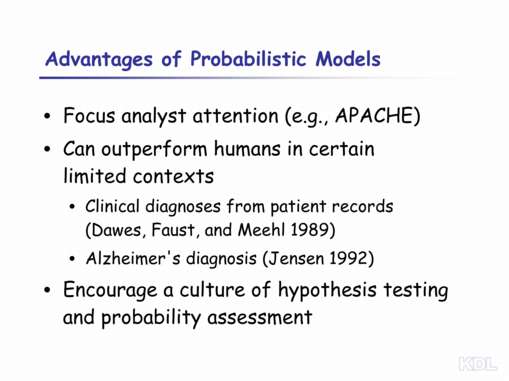
| Probabilistic models constructed by data mining algorithms can substantially improve human decision making. First, they can focus analysts' attention on those cases that are particularly important. For example, one type of statistical model — the APACHE (Acute Physiology And Chronic Health Evaluation) system — is used in many U.S. intensive care units to predict an individual patient's risk of death. Among other uses, doctors employ the system to readjust priorities — if APACHE's estimate differs substantially from their own, doctors look deeper, searching for underlying medical conditions they may have missed. Second, probabilistic models can outperform human decision makers in certain limited contexts. For example, given only the information in a case file, relatively simple statistical models have been shown to be as accurate as, or more accurate than, trained clinicians at diagnosing psychiatric conditions. This finding has persisted over a wide variety of settings and study designs. Anecdotally, I had a similar experience when building models for Alzheimer's diagnosis. Nearly every model that my algorithms built misdiagnosed one particular case in our sample of patients. My models predicted that the patient was perfectly healthy, while the clinical diagnosis indicated the patient had Alzheimer's dementia. When I inquired about the patient, whom I knew only by a number, my contact at the Medical School, an eminent diagnostician, was emphatic. "Oh, they got that one wrong," she said. "He's fine." The patient, it turned out, had been eccentric his entire life. His personality had been mistaken for dementia. Finally, a focus on constructing and testing statistical models can encourage organizations to adopt a culture of hypothesis testing. Rather than using hunches and personal intuition alone, some organizations encourage the explicit statement and testing of ideas, particularly those that can be stated quantitatively. Data mining can help foster that type of organizational culture. |