 |
 |
 |
| To give you a flavor of some of the research that is being funded by these programs, let me tell you about some of the work going on in my laboratory.
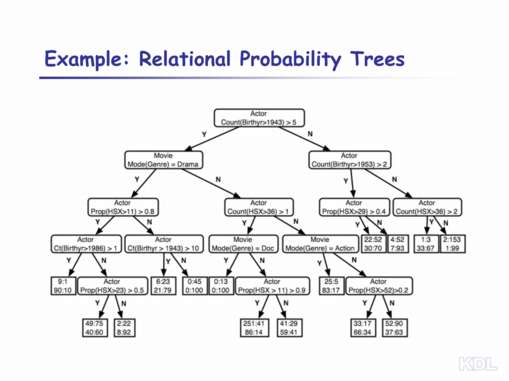
Above is a type of statistical model we devised recently called a "relational probability tree". I know you probably can't make out the detail in this tree, so I'll show you an expanded version in a minute. For now, though, I would like you to concentrate on the overall structure of the tree. These trees work like virtual pachinko machines — you insert a fragment of relational data at the top of the tree, and it rattles down the tree until it reaches a "leaf node" at the bottom of the tree. The leaf node assigns a probability distribution to the data fragment. For example, this tree was constructed to predict whether a movie will make more than $2 million in its opening weekend. The data fragment inserted at the top of the tree is a movie and all its associated actors, producers, directors, and studios. Based on the characteristics of the movie and its relational neighborhood (actors, directors, etc.), the tree predicts the probability that the movie will make more than $2 million during its first weekend. Let's expand a portion of the tree... |