 |
 |
 |
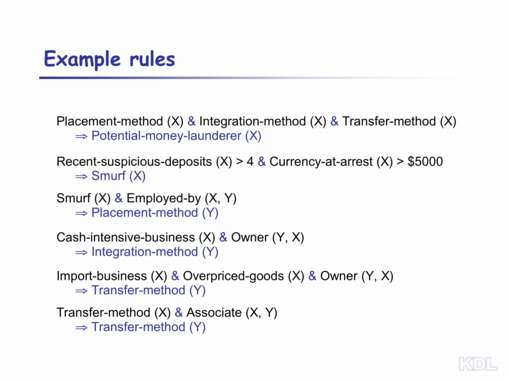
| Here are a few rules that might be used to detect money laundering. I've expressed these rules in a way that is similar to how they might be expressed in a knowledge-based system — a software system for automatically detecting money laundering.
The first rule indicates that money laundering is often thought to consist of three phases: 1) a placement phase where the proceeds of some criminal activity enter the banking system; 2) an integration phase where the money is made to appear legitimate; and 3) a transfer phase where the money is transferred out of the country, beyond the reach of U.S. law enforcement. The rule states that if you have a placement method, an integration method, and a transfer method, you have the potential to launder money. The second and third rules state the conditions for a placement method called "smurfing" (the method is named after the industrious little blue characters that used to appear on Saturday morning cartoons). Smurfing occurs when one or more individuals make many small deposits to bank accounts in an effort to evade the $10,000 reporting requirement. This is a way to "leak" money into the banking system without alerting Treasury. If a person has made many such deposits and is still carrying a substantial amount of cash, they may be a smurf. If someone employs a smurf, then they have a placement method. The fourth rule states that if someone owns a cash intensive business (e.g., a restaurant, bar, or casino), then they have an integration method — a "cover story" for cash obtained by illegal means. The last two rules state that if someone owns an import business and they import overpriced goods, then they have a transfer method. The idea is that you import a worthless commodity (e.g., a crate of sand), you claim that the crate contains expensive goods (e.g., jewelry or electronics), and you transfer money overseas to pay for the supposedly expensive goods. Of course, if someone has an associate with a transfer method, then they have a transfer method. A few caveats: First, these rules are vastly simpler than would be needed for a practical system for money laundering detection. A practical system would probably need thousands of such rules, and many of the rules would be substantially more complex than the ones shown here. Second, rules in any practical system would need to be probabilistic. The rules shown above are stated as if they are certain, and they would not be. Finally, to my knowledge, no operational system for using rules such as these is in use today, partially because of the difficulties I will mention in a few minutes. Systems that can reason effectively about such interconnected webs of probabilistic evidence are an area of active research today. |